UAE Perspectives

Artificial Intelligence & Technology

Abu Dhabi’s IFM Launches K2 Horizon, Largest Open-Source AI in History

September 2026

The Institute of Foundation Models (IFM) has launched K2 Horizon, the largest fully open-source AI model release in history. The fleet of six models ranges from a 0.9-billion-parameter model small enough to run on a watch to a 375-billion-parameter flagship model built for enterprise servers. Every model ships with full training data, code and methodology.

IFM, a global AI frontier lab launched by Abu Dhabi's Mohamed bin Zayed University of Artificial Intelligence (MBZUAI) in May 2025, employs AI researchers, scientists and developers across three offices in Abu Dhabi, Paris and Silicon Valley.

Why This Matters

K2 Horizon positions IFM as a global leader in AI transparency, building open-source models that are both trusted and highly competitive. The fleet was engineered in part at IFM's Silicon Valley lab, a direct bridge that embeds American AI talent into the heart of the UAE's frontier research effort. K2 Horizon models are available immediately through Hugging Face, vLLM and SGLang, putting UAE-built AI in the hands of American developers and researchers.

“Science works when others can see the data, follow the method, reproduce the result, and improve on it. K2 Horizon delivers on that need… This is open science, and we believe it’s the best path forward for AI.” – Eric Xing, Founder of IFM and President and University Professor of MBZUAI

Full Press Release: Institute of Foundation Models Launches the Industry’s Largest Fully Open-Source Fleet of AI Models: Complete with Weights, Code, Training Data and Methodologies

K2 Horizon Enables Greater Access and Reproducibility for Researchers and Developers Worldwide; Ready to Deploy from Edge to Enterprise

ABU DHABI, UAE, September 3, 2026 — The Institute of Foundation Models (IFM) today introduced K2 Horizon, a new fleet of six AI foundation models ranging from 0.9 billion to 375 billion parameters. The new models are fully open—including model weights, code, training data and methodologies—allowing researchers and developers to inspect, reproduce and adapt the models for their own work.

Across reasoning, mathematics, coding and agentic tasks, K2 Horizon delivers top-tier performance in every size class—with the 0.9B, 3.7B and 7B models setting new state of the art at their respective scales. The 0.9B model is designed for highly constrained

environments such as watches and glasses, while the 3.7B and 7B models bring advanced capabilities to phones and other on-device applications.

The dense 32B model and sparse 36B-A4B model provide powerful options for local hosting and on-premise servers. The 375B-A23B model brings the fleet’s strongest capabilities to demanding enterprise deployments.

Today’s release is an important step forward for the global AI community, as K2 Horizon represents the largest fully open-source model launch in AI history, giving developers and researchers greater choice in capabilities, scale and deployment options.

The six models share a core architecture, vocabulary, training methodology, interfaces and deployment tooling, with a smaller vocabulary for the 0.9B model. IFM’s dynamic model routing technique directs tasks to the most cost-effective model and provides developers with a practical path from prototype to production. Plus, the fully open code, training data and recipes are a significant step forward in transparency, well beyond the “open weights” dialogue that has dominated AI industry headlines over recent weeks.

“Open source is much more than open weights. Science works when others can see the data, follow the method, reproduce the result, and improve on it,” said Eric Xing, Founder of IFM, and President and University Professor of MBZUAI. “K2 Horizon delivers on that need. Every model in the fleet ships with its training data, recipe and evaluations. This is open science, and we believe it’s the best path forward for AI.”

Today’s launch also marks IFM's expansion as a global AI frontier lab. Launched by Mohamed bin Zayed University of Artificial Intelligence (MBZUAI) in May 2025, IFM now employs AI researchers, scientists and developers across three offices in Silicon Valley, Paris and Abu Dhabi.

K2 Horizon includes key technology innovations: 1) A unique “diffusion distillation” technique that generates blocks of tokens in parallel, which speeds model performance by roughly 3X without degrading response quality; and 2) A “mixture of value attention” architecture that improves reasoning without adding more computation.

IFM engineered each K2 Horizon model to compete with the best open models of comparable size on reasoning, tool use, and agentic tasks. The smallest model is designed for devices where memory, power consumption and local processing matter. The largest model is intended for demanding reasoning and enterprise AI workloads. Developers can prototype on smaller models and scale to larger models without leaving the K2 Horizon fleet – no changes required to deployment workflows.

Model Highlights

  • 0.9B: the industry’s best-performing model of its size in math, reasoning, and tool use; small enough to run on a watch.
  • 3.7B: a fine-tuning-friendly size for developers and researchers, with reasoning that is the industry’s best under 4B and matches or beats many larger models.
  • 7B: the industry’s best-performing model under 10B, with strong software engineering and deep research ability; small enough to run on a phone.
  • 32B: among the most capable dense models for local hosting; built for heavy use on laptops and on-prem servers.
  • 36B (4B active): a new Mixture of Value Attention (MoVA) architecture that outperforms many larger models while activating only 4B parameters, which makes the model cost-effective for local hosting.
  • 375B (23B active): K2 Horizon’s flagship model, built to compete with open-weight models on reasoning and agentic work, and ready for the enterprise.

“Rather than release a single model, we’re releasing an entire fleet at once — six models, from one small enough to run on a watch to a flagship built for enterprise reasoning,” said Hector Liu, director of IFM’s Silicon Valley lab. “Every model is built to compete with the best open models at its size, and every one ships with the weights, code, training data and methodology behind it. Developers can prototype on the smallest model, scale to the flagship, and verify every claim we make along the way.”

K2 Horizon models are available immediately through Hugging Face, as well as vLLM and SGLang. The API of K2 Horizon is available today through IFM’s global ecosystem of inference partners, including Compass, Cerebras, AWS and Nebius. K2 Horizon models and code are released under the Apache 2.0 license.

About the Institute of Foundation Models (IFM)

The Institute of Foundation Models (ifm.ai) is a global AI research lab dedicated to open and independent development of frontier-class foundation models. Launched in May 2025 by MBZUAI, IFM operates from advanced lab facilities in Abu Dhabi, Silicon Valley and Paris. IFM’s model portfolio includes K2 series, the fully open-source fleet of LLMs; Jais, the most advanced Arabic LLM; and PAN, the next-gen World Model for embodied reasoning and real-world simulation.

About Mohamed bin Zayed University of Artificial Intelligence

Mohamed bin Zayed University of Artificial Intelligence (MBZUAI) is a research university in Abu Dhabi. Founded in 2019, it enrolled its first graduate students in 2021 and opened a highly selective undergraduate program in 2025. Recognized globally for its research excellence, it has nearly a thousand students from more than 50 countries. Learn more at mbzuai.ac.ae
Related

View All

Artificial Intelligence & Technology

Abu Dhabi’s IFM Launches K2 Horizon, Largest Open-Source AI in History

September 4, 2026

0

min read

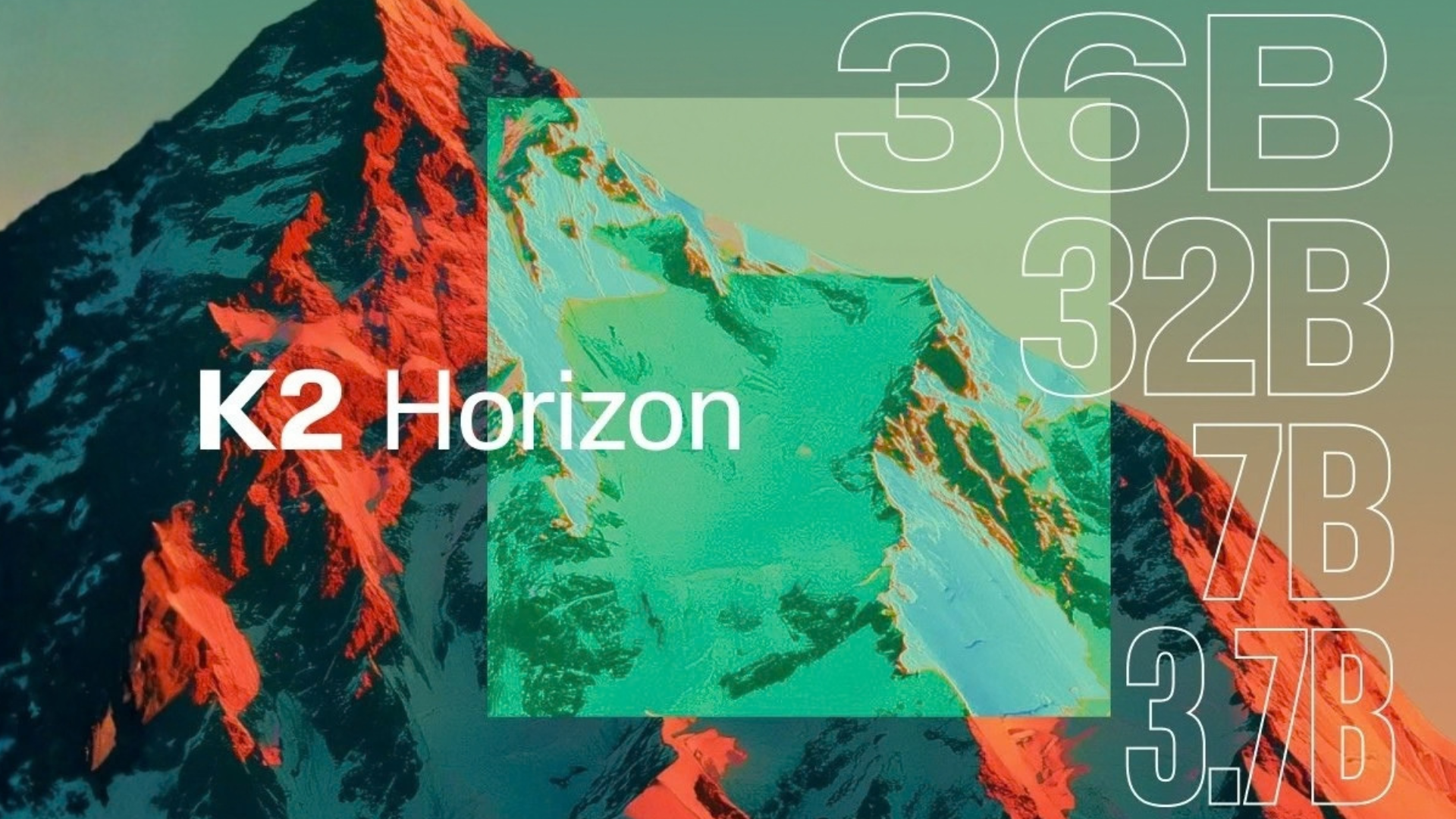
K2 Horizon launch graphic featuring a stylized multicolored mountain and six AI model sizes: 375B, 36B, 32B, 7B, 3.7B and 0.9B.

The Institute of Foundation Models (IFM) has launched K2 Horizon, the largest fully open-source AI model release in history. The fleet of six models ranges from a 0.9-billion-parameter model small enough to run on a watch to a 375-billion-parameter flagship model built for enterprise servers. Every model ships with full training data, code and methodology.

IFM, a global AI frontier lab launched by Abu Dhabi's Mohamed bin Zayed University of Artificial Intelligence (MBZUAI) in May 2025, employs AI researchers, scientists and developers across three offices in Abu Dhabi, Paris and Silicon Valley.

Why This Matters

K2 Horizon positions IFM as a global leader in AI transparency, building open-source models that are both trusted and highly competitive. The fleet was engineered in part at IFM's Silicon Valley lab, a direct bridge that embeds American AI talent into the heart of the UAE's frontier research effort. K2 Horizon models are available immediately through Hugging Face, vLLM and SGLang, putting UAE-built AI in the hands of American developers and researchers.

“Science works when others can see the data, follow the method, reproduce the result, and improve on it. K2 Horizon delivers on that need… This is open science, and we believe it’s the best path forward for AI.” – Eric Xing, Founder of IFM and President and University Professor of MBZUAI

Full Press Release: Institute of Foundation Models Launches the Industry’s Largest Fully Open-Source Fleet of AI Models: Complete with Weights, Code, Training Data and Methodologies

K2 Horizon Enables Greater Access and Reproducibility for Researchers and Developers Worldwide; Ready to Deploy from Edge to Enterprise

ABU DHABI, UAE, September 3, 2026 — The Institute of Foundation Models (IFM) today introduced K2 Horizon, a new fleet of six AI foundation models ranging from 0.9 billion to 375 billion parameters. The new models are fully open—including model weights, code, training data and methodologies—allowing researchers and developers to inspect, reproduce and adapt the models for their own work.

Across reasoning, mathematics, coding and agentic tasks, K2 Horizon delivers top-tier performance in every size class—with the 0.9B, 3.7B and 7B models setting new state of the art at their respective scales. The 0.9B model is designed for highly constrained

environments such as watches and glasses, while the 3.7B and 7B models bring advanced capabilities to phones and other on-device applications.

The dense 32B model and sparse 36B-A4B model provide powerful options for local hosting and on-premise servers. The 375B-A23B model brings the fleet’s strongest capabilities to demanding enterprise deployments.

Today’s release is an important step forward for the global AI community, as K2 Horizon represents the largest fully open-source model launch in AI history, giving developers and researchers greater choice in capabilities, scale and deployment options.

The six models share a core architecture, vocabulary, training methodology, interfaces and deployment tooling, with a smaller vocabulary for the 0.9B model. IFM’s dynamic model routing technique directs tasks to the most cost-effective model and provides developers with a practical path from prototype to production. Plus, the fully open code, training data and recipes are a significant step forward in transparency, well beyond the “open weights” dialogue that has dominated AI industry headlines over recent weeks.

“Open source is much more than open weights. Science works when others can see the data, follow the method, reproduce the result, and improve on it,” said Eric Xing, Founder of IFM, and President and University Professor of MBZUAI. “K2 Horizon delivers on that need. Every model in the fleet ships with its training data, recipe and evaluations. This is open science, and we believe it’s the best path forward for AI.”

Today’s launch also marks IFM's expansion as a global AI frontier lab. Launched by Mohamed bin Zayed University of Artificial Intelligence (MBZUAI) in May 2025, IFM now employs AI researchers, scientists and developers across three offices in Silicon Valley, Paris and Abu Dhabi.

K2 Horizon includes key technology innovations: 1) A unique “diffusion distillation” technique that generates blocks of tokens in parallel, which speeds model performance by roughly 3X without degrading response quality; and 2) A “mixture of value attention” architecture that improves reasoning without adding more computation.

IFM engineered each K2 Horizon model to compete with the best open models of comparable size on reasoning, tool use, and agentic tasks. The smallest model is designed for devices where memory, power consumption and local processing matter. The largest model is intended for demanding reasoning and enterprise AI workloads. Developers can prototype on smaller models and scale to larger models without leaving the K2 Horizon fleet – no changes required to deployment workflows.

Model Highlights

  • 0.9B: the industry’s best-performing model of its size in math, reasoning, and tool use; small enough to run on a watch.
  • 3.7B: a fine-tuning-friendly size for developers and researchers, with reasoning that is the industry’s best under 4B and matches or beats many larger models.
  • 7B: the industry’s best-performing model under 10B, with strong software engineering and deep research ability; small enough to run on a phone.
  • 32B: among the most capable dense models for local hosting; built for heavy use on laptops and on-prem servers.
  • 36B (4B active): a new Mixture of Value Attention (MoVA) architecture that outperforms many larger models while activating only 4B parameters, which makes the model cost-effective for local hosting.
  • 375B (23B active): K2 Horizon’s flagship model, built to compete with open-weight models on reasoning and agentic work, and ready for the enterprise.

“Rather than release a single model, we’re releasing an entire fleet at once — six models, from one small enough to run on a watch to a flagship built for enterprise reasoning,” said Hector Liu, director of IFM’s Silicon Valley lab. “Every model is built to compete with the best open models at its size, and every one ships with the weights, code, training data and methodology behind it. Developers can prototype on the smallest model, scale to the flagship, and verify every claim we make along the way.”

K2 Horizon models are available immediately through Hugging Face, as well as vLLM and SGLang. The API of K2 Horizon is available today through IFM’s global ecosystem of inference partners, including Compass, Cerebras, AWS and Nebius. K2 Horizon models and code are released under the Apache 2.0 license.

About the Institute of Foundation Models (IFM)

The Institute of Foundation Models (ifm.ai) is a global AI research lab dedicated to open and independent development of frontier-class foundation models. Launched in May 2025 by MBZUAI, IFM operates from advanced lab facilities in Abu Dhabi, Silicon Valley and Paris. IFM’s model portfolio includes K2 series, the fully open-source fleet of LLMs; Jais, the most advanced Arabic LLM; and PAN, the next-gen World Model for embodied reasoning and real-world simulation.

About Mohamed bin Zayed University of Artificial Intelligence

Mohamed bin Zayed University of Artificial Intelligence (MBZUAI) is a research university in Abu Dhabi. Founded in 2019, it enrolled its first graduate students in 2021 and opened a highly selective undergraduate program in 2025. Recognized globally for its research excellence, it has nearly a thousand students from more than 50 countries. Learn more at mbzuai.ac.ae

MGX and Silver Lake Take Majority Stake in Intel’s Altera

News

MGX and US Partners Acquire $40 Billion Texas-Based Data Center Operator

News

MGX-backed Group Commits $5B to Aligned Data Centers After $40B Deal

Suggested Content

CNTXT AI Expands into Silicon Valley With $300M+ In Committed Revenue

October 21, 2026

Microsoft's Growing UAE Investment

October 21, 2026

Ambassador Al Otaiba: The UAE-US Partnership Keeps Delivering

October 21, 2026