UAE Perspectives

No items found.

Pax Silica and the UAE-US Partnerships Turning AI Ambition into Reality

July 2026

The UAE is all in on the United States when it comes to artificial intelligence. Our institutions and infrastructure are built around this partnership. We are investing across every layer of the American AI ecosystem — from the innovators developing new AI applications to the energy, semiconductor manufacturing and infrastructure that make them possible. None of this happened by accident. It took years of relationship-building, careful groundwork and a track record of trust.

I have spent enough time in this work to know that the days that matter most rarely look dramatic from the outside. They look like meetings. Like follow-up. Like the same handful of people showing up, again and again, to move something forward an inch at a time. Last week in Washington was one of those weeks, and it reminded me why I do this.

The partnership was on full display. Minister of State HE Saeed Al Hajeri led the UAE delegation to the second Pax Silica Summit, joined by HE Omran Sharaf and leading UAE technology institutions including Core42, G42, MGX and TDRA. By the summit’s end, thirty-five nations had signed the Joint Statement on AI Opportunity, recommitting to pro-innovation policy, private sector R&D and resilient tech supply chains.

What strikes me the most about a gathering like this is how much of the real work happens off to the side, in the room no one writes about. Trust doesn’t get announced — it gets earned. Watching it come together — alongside people who have given years to this work — was a moment worth pausing on.

The UAE joined Pax Silica in January 2026. It was a natural next step in decades of technology cooperation, and part of the broader $1.4 trillion UAE-US economic and technology framework that I am proud to help advance.

As UAE Ambassador Yousef Al Otaiba put it, "by joining Pax Silica, the UAE is reinforcing a core principle we share with the United States: that the future of artificial intelligence must be grounded in trust and resilient global partnerships." You can see what it looks like in practice. G42's Common Operating Picture framework, for instance, gives US partners continuous, verifiable visibility over US-origin AI semiconductors deployed in the UAE.

In my experience, this kind of trust can only be built transaction by transaction, agreement by agreement, year by year. There are no shortcuts.

The rest of the picture reflects the same commitment. Advanced US AI chips arrived in the UAE in May 2026, with more on the way. The 5GW UAE-US AI Campus in Abu Dhabi, built jointly by G42 and US firms, brings its first 500MW online this year. Core42 is tripling its US data center capacity. The UAE is investing in frontier American AI companies including Anthropic and xAI. And Mubadala-backed GlobalFoundries just received a $375 million award from the US Department of Commerce to establish a dedicated US quantum foundry.

None of this is new. We have been laying the groundwork for nearly a decade. The UAE appointed its Minister of State for AI in 2017. Today, the UAE has the highest rate of AI diffusion globally, and UAE President HH Sheikh Mohamed bin Zayed Al Nahyan has set a target of running 50 percent of all federal government operations on agentic AI within two years.

The numbers tell the story of what sustained partnership produces. US goods exports to the UAE reached $31.4 billion in 2025, generating a $23.8 billion trade surplus, the largest in the MENA region and the fourth largest US goods trade surplus globally. For 17 consecutive years, the UAE has been the United States' top export destination in the Middle East and North Africa. Bilateral trade reached a record $39 billion in 2025.

I find myself returning to those figures often, but not for the reasons you might expect. Behind every one of them are relationships, negotiations, investments made and commitments kept. Numbers are just the visible surface of years of patient, human effort. But what matters even more is what comes next. The architecture being laid today — in AI, in infrastructure, in trade — will determine how both countries compete and lead over the next decade.

I am proud to play a part in it. And I am even prouder of the people I get to do it with.
Related

View All
Preferred Views

Pax Silica and the UAE-US Partnerships Turning AI Ambition into Reality

Written By
Jawaher Almheiri

UAE Commercial Attaché to the US

July 2026

0

min read

The UAE is all in on the United States when it comes to artificial intelligence. Our institutions and infrastructure are built around this partnership. We are investing across every layer of the American AI ecosystem — from the innovators developing new AI applications to the energy, semiconductor manufacturing and infrastructure that make them possible. None of this happened by accident. It took years of relationship-building, careful groundwork and a track record of trust.

I have spent enough time in this work to know that the days that matter most rarely look dramatic from the outside. They look like meetings. Like follow-up. Like the same handful of people showing up, again and again, to move something forward an inch at a time. Last week in Washington was one of those weeks, and it reminded me why I do this.

The partnership was on full display. Minister of State HE Saeed Al Hajeri led the UAE delegation to the second Pax Silica Summit, joined by HE Omran Sharaf and leading UAE technology institutions including Core42, G42, MGX and TDRA. By the summit’s end, thirty-five nations had signed the Joint Statement on AI Opportunity, recommitting to pro-innovation policy, private sector R&D and resilient tech supply chains.

What strikes me the most about a gathering like this is how much of the real work happens off to the side, in the room no one writes about. Trust doesn’t get announced — it gets earned. Watching it come together — alongside people who have given years to this work — was a moment worth pausing on.

The UAE joined Pax Silica in January 2026. It was a natural next step in decades of technology cooperation, and part of the broader $1.4 trillion UAE-US economic and technology framework that I am proud to help advance.

As UAE Ambassador Yousef Al Otaiba put it, "by joining Pax Silica, the UAE is reinforcing a core principle we share with the United States: that the future of artificial intelligence must be grounded in trust and resilient global partnerships." You can see what it looks like in practice. G42's Common Operating Picture framework, for instance, gives US partners continuous, verifiable visibility over US-origin AI semiconductors deployed in the UAE.

In my experience, this kind of trust can only be built transaction by transaction, agreement by agreement, year by year. There are no shortcuts.

The rest of the picture reflects the same commitment. Advanced US AI chips arrived in the UAE in May 2026, with more on the way. The 5GW UAE-US AI Campus in Abu Dhabi, built jointly by G42 and US firms, brings its first 500MW online this year. Core42 is tripling its US data center capacity. The UAE is investing in frontier American AI companies including Anthropic and xAI. And Mubadala-backed GlobalFoundries just received a $375 million award from the US Department of Commerce to establish a dedicated US quantum foundry.

None of this is new. We have been laying the groundwork for nearly a decade. The UAE appointed its Minister of State for AI in 2017. Today, the UAE has the highest rate of AI diffusion globally, and UAE President HH Sheikh Mohamed bin Zayed Al Nahyan has set a target of running 50 percent of all federal government operations on agentic AI within two years.

The numbers tell the story of what sustained partnership produces. US goods exports to the UAE reached $31.4 billion in 2025, generating a $23.8 billion trade surplus, the largest in the MENA region and the fourth largest US goods trade surplus globally. For 17 consecutive years, the UAE has been the United States' top export destination in the Middle East and North Africa. Bilateral trade reached a record $39 billion in 2025.

I find myself returning to those figures often, but not for the reasons you might expect. Behind every one of them are relationships, negotiations, investments made and commitments kept. Numbers are just the visible surface of years of patient, human effort. But what matters even more is what comes next. The architecture being laid today — in AI, in infrastructure, in trade — will determine how both countries compete and lead over the next decade.

I am proud to play a part in it. And I am even prouder of the people I get to do it with.

Read More
About the Author

Jawaher Almheiri

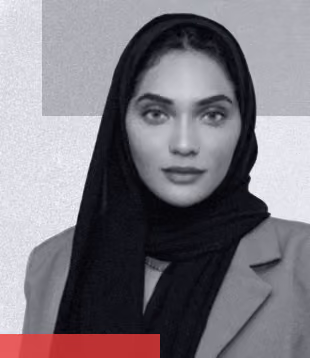
Jawaher Almheiri is an economic strategist and commercial leader who operates at the intersection of government, capital, and industry. Throughout her career, she has helped translate national economic priorities into investments, commercial opportunities, and long-term economic value.

As UAE Commercial Attaché to the United States and Head of Economic Policy at the UAE Embassy in Washington, D.C., Jawaher advances the UAE’s economic priorities across trade, investment, technology, and industry. She works closely with U.S. government agencies, investors, financial institutions, and corporate leaders to strengthen economic ties between the UAE and the United States. Her work spans economic policy, sovereign capital, trade and investment promotion, advanced technologies, and strategic partnerships.

Prior to Washington, Jawaher led economic affairs portfolios across Asia within the UAE Ministry of Foreign Affairs, overseeing key relationships with major economies including China, India, Japan, and ASEAN member states.

Jawaher holds a Master of International Affairs from Columbia University, specializing in International Finance and Economic Policy, and is currently pursuing the CFA Program. She is a Forbes 30 Under 30 Middle East alumna and a recipient of the Distinguished Diplomat Medal awarded by H.H. Sheikh Abdullah bin Zayed Al Nahyan.

Outside of her professional work, she follows global markets and economic policy and writes on issues shaping the future of trade, investment, and competitiveness.